15 March 2012

Who Best to Read out Beowulf?

Latter-day scops (poets and singers) still tell Beowulf aloud, both in the Old English and the new. Among those who use the Old, Benjamin Bagby is unique. He has memorized sections of the poem and performs them in a mixture of dramatic story-telling and song. He accompanies himself on a reproduction of an Anglo-Saxon harp. I cannot say if his style is the same as the old scops', but it is the best effort that has been made, and is thrilling in its own right. Here are are links to two short samples: the opening lines and Grendel's ambush.


Anyone interested in Beowulf should consider getting the dvd of Bagby's full performance.

A free recording of the Gummere translation, read by Kara Schallenberg, was released as part of the Librivox project. However, when I imagine my translation being read aloud, I hear a different type of voice speaking it.
First, it is a man's voice. With no disrespect meant to Ms. Schallenberg, Beowulf is a story by, for, and about men. If a woman was given Queen Wealhtheow's lines to speak, which are almost the only lines attributed to a woman, then she would have only thirty-five lines out of more than three thousand.

Next, it should be a slow, deliberate voice that gives appropriate weight to the alliteration and action, and a deeper voice would be better than a higher one.

Finally, I must admit that I hear it in my head spoken with a West Country accent...one from the counties to the west and South of London: Wiltshire, Somerset, Avon, Devon and the like. If you are not familiar with this manner of speech, think of pirates talking, or Sam Gamgee in The Lord of the Rings movies, or Hagrid in the Harry Potter movies. In fact, Robbie Coltrane, the actor who plays Hagrid, would do a fine job, Scot though he is.

However, the best voice I've heard for the reading of Beowulf, even though I do not believe he has ever done it, belongs to a Yorkshire-born actor, Jim Carter, who played Lord Faa of the Gyptian folk in the film The Golden Compass. These lines of his could be considered an audition for the job of reading Beowulf. 
When the time comes to punish, we shall strike such a blow as'll make their hearts faint and fearful. We shall strike the strength out of 'em. We shall leave them ruined and wasted, broken and shattered, torn in a thousand pieces and scattered to the four winds.
Now that's an alliteration-heavy formal boast very close in spirit and style to Beowulf's own, and Carter delivers it perfectly.

One reason that I imagine Beowulf read in a West Country accent is that I was born in that part of England and would probably have that accent myself, if my family had not emigrated. A better reason is that this accent is the most direct descendant of the Old English language that Beowulf was written in.

Wikipedia puts it this way: "The West Country dialects derive not from a corrupted form of modern English, but reflect the historical origins of the English Language and its historical pronunciation, in particular Late West Saxon, which formed the earliest English language standard, from the time of King Alfred until the late 11th century.")

To get an idea of its sound, listen to this Wiltshireman, Phil Harding, being interviewed. 

Another accent that would sound "right" to me, though, is Yorkshire's. After all, it descends from Viking language, spoken by invading Danes, and much of Beowulf is the about those Danes. Here's what it sounds like, unadulterated, and here's Jim Carter himself in an interview.

-------------------------

Late breaking. I'd wanted to include a clip of Jim Carter saying his little speech of vengeance, but can't find one on-line. This one, however, does include him in character as Lord Faa.

11 March 2012

Fourth Chunk of Fitt XXXV, and a Small Request

Writing, for many people, including me, keeps the writer and the audience pretty separate. I know how many hits this site gets in a day, but I don't know who comes, why, or what they think of the translation so far. I'd appreciate it if you take a moment during your visit to let me know something about yourself and your thoughts on this project. It needn't be much, but it would be appreciated.

--------------------------------------------

Then he let his rage rise from his lungs,
a word went out from the Weder lord,
the staunch-heart stormed. A strident call
rang out against the grey pale rocks.
Hatred was raised. The hoard's guard knew
the voice of a man. No moment was left
to try for a truce. The tunnel released
breath from the beast, burning vapour
out of the stone. The earth thundered.

The knight swung shield, beneath the tomb,
to the loathesome guest, the Geats' leader.
Then, coiled and hooped, its heart compelled it
to search out a fight. He drew his sword,
an ancient heirloom, the excellent war-king,
rash with edges, and each of the pair
of opposing foes feared the other.
With stern spirit he stood with his steep-bossed shield,
first among friends, as the firedrake coiled,
winding in haste. He waited in harness.

04 March 2012

Third Chunk of Fitt XXXV

This, again, is a rough draft. Still, putting lines up in this state helps to boost my spirit by showing some forward movement. With any luck, you'll like what I have, too.

This takes us from lines 2534 to 2549. When I reach the end of the Fitt (line 2601), it will be a substantial milestone. I will have finished almost exactly 80% of the translation.

Beowulf continues his address to his men and spots a steaming, deadly stream emerging from the entrance to the tomb. He realizes that he cannot survive if he enters. The dragon's heat and poisonous breath would overcome him.
----------------------------------------------------------------------
He knew the terror would take all his strength
and prove his worth. "I must go bravely 2535
"and gain the gold, or give up to war--
"from vicious wounds--your very lord."

The strong one stood, steadied by his shield,
hard under helmet, hauberk in place,
under cliffs of stone; staking all on the power 2540
of a man alone, not like a coward.

He saw by the wall then, the worthy lord,
who emerged alive from many battles,
clashes of arms, when armies collided,
that a stone arch was standing. A stream emerged 2545
that broke from the barrow. The brook's current
had deadly heat. The hoard beyond it
he could never near, not for an instant,
nor endure the deeps for the dragon's flame. 2549

28 February 2012

Smaug and The Hobbit movie

Here is Tolkien's illustration of the dragon, Smaug, on his hoard. A small thief can be seen on the right side. Like the dragon in Beowulf that clearly inspired his creator, Smaug is enraged by a theft from his hoard and flies off to punish the nearby settlement with flame.


Smaug appears in Tolkien's book The Hobbit. He describes it like this (pp. 205-6):

There he lay, a vast red-golden dragon, fast asleep; a
thrumming came from his jaws and nostrils, and wisps
of smoke, but his fires were low in slumber. Beneath
him, under all his limbs and his huge coiled tail, and
about him on all sides stretching away across the
unseen floors, lay countless piles of precious things,
gold wrought and un-wrought, gems and jewels, and
silver red-stained in the ruddy light.

Smaug lay, with wings folded like an immeasurable bat,
turned partly on one side, so that the hobbit could see
his underparts and his long pale belly crusted with
gems and fragments of gold from his long lying on his
costly bed. Behind him where the walls were nearest
could dimly be seen coats of mail, helms and axes,
swords and spears hanging; and there in rows stood
great jars and vessels filled with a wealth that could
not be guessed.
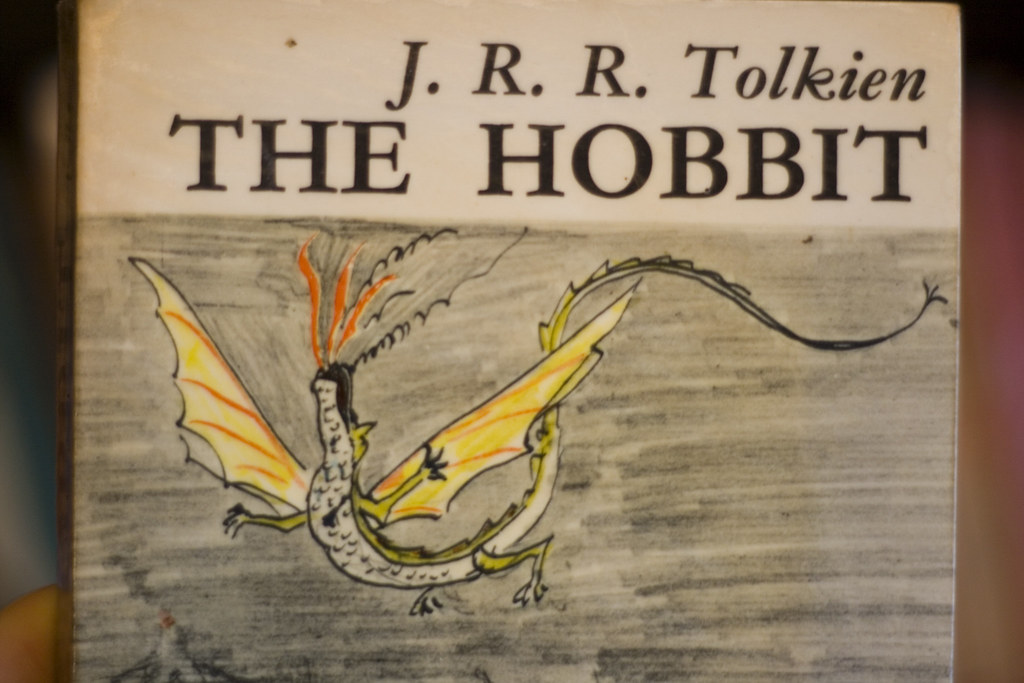
 Another of Tolkien's own drawings appears on the cover of the book. (The same edition I owned, by the way).


This is Smaug dying from an arrow that hit a small patch of his breast that was not encrusted with the treasure he had lain on. Beneath him, a village burns.


Thanks to the site smaugthemagnicent for putting up some of these scans.

By the way, The Hobbit is being made into a pair of films and the trailer is available. Unfortunately, Smaug does not appear in the trailer.


Here's another video from the movie's set.


Second Chunk of Fitt XXXV

Beowulf continues speaking to his men before fighting the dragon.

He backs up his claim that, past and present, he never shirks a fight by mentioning how he had killed Daeghrefn (Day-raven), whom I assume had killed Haethcyn. Although he could accomplish that without a sword, both "hand and weapon" would be needed now. Presumably, Beowulf is hinting not only that the dragon is a stronger opponent but that Beowulf himself is older than he was, and past his physical prime. He never says this directly.

The "breast adornment" that Daeghrefn fails to carry to the Frisian king may be the one that went from Wealhtheow to Hygd.

He instructs his men to stay close, but out of the fight, as he is the only one strong enough to face the dragon. He hints that he is not strong enough to survive the dragon, however: his men "can better/survive their wounds in the violent clash/than I am able."

This is still a bit rough. A couple of lines aren't properly formed, and others could be  improved, but I didn't want to make you wait too long.

------------------------------------------------------

"I was always out in the front
"of the battle line, and always must
"be so in battle, while my blade endures,
"which, past and present, proved itself often
"since I, in the front lines felled Daeghrefn,
"killed by my hand, the Hugas' champion.
"He fetched no riches for the Frisian king
"could bring back no breast adornment,
"but that flag bearer fell with his band.
"the noble in courage. No blade killed him
"but my hard grip halted his heart's beating,
"and his bone-house broke. The blade's edge must now
"fight for the hoard, hand and weapon."

Beowulf said a solemn vow,
the last he would make. "Many trials
"I risked in my youth, and yet I wish,
"old folk defender, to find redress,
"to earn honour, if the evil one
"climbs from his cave to confront me."

He paid honour to each person,
fearless fighters, one final time,
his brothers in arms. "I would bear no sword
"no worm-killer weapon, if a way were found
"to let me go against the beast,
"grapple for glory, as with Grendel before,
"but I expect that flame will pour out in fury
"poisonous, choking, so I chose to bring
"byrnie and board. From the barrow-guard
"I will not flee a foot, but we face whatever
"befalls at the the wall, as fate determines,
"the Maker of men. My mind is bold
"so I will not boast against the war-flyer."

"Stay by the barrow, byrnie wearers,
"harnessed heroes, who can better
"survive their wounds in the violent clash
"than I am able. It is not your fight.
"No other is able. I only have the power"

14 February 2012

Miniskirts poem

It's Valentine's Day, so this bit of fluff I wrote is vaguely relevant. :-)

---------------------------- 
Miniskirts must madden the eye,
haul round the head, hammer the reason.
The pupil dilates to let in the light,
giving a golden glow to the girl.

No crumb of comfort comes to the boy
Till age gives him ease, if it ever does.

09 February 2012

The First Chunk of Fitt XXXV.

This Fitt is a long one, so I will put it up in parts.

The first 2.5 lines finish the Father's Lament,  describing the grief of a father whose son has died and who has no recourse to justice (wergild--payment in return for a death) or revenge. That feeling is then ascribed to King Hrethel of the Geats when one of his sons (Haethcyn) accidentally kills another (Herebeald). Then Hrethel dies.

Once Hrethel was gone, King Ongentheow of Sweden and his sons begin to harry the Geats. Hygelac, now the Geats' king, gave battle at Hreosnabeorh (Hreosna Hill). Haethcyn died, then a warrior named Eofor killed Ongentheow.

The family tree below, from this page, may make things clearer.


                                 Hreðel
                                    |
             ---------------------------------------------
             |              |             |              |
          Herebeald       Hæþcyn       Hygelac        daughter       Ecgþeow
                                          |              |              | 
                                          |              ----------------
                          Hygd            |                       |
                            |             |                    Beowulf 
                            --------------                   
                                   |
                            --------------
                            |             |
                         Heardred      daughter       Eofor
                                          |            |
                                          --------------


---------------------------
He goes to his chambers and chants laments,        2460
a man for a man. The manse and fields
feel all too large. So the refuge of Weders—
his heart's sorrow for Herebeald's sake
ever deeper—endured without hope
of having amends made for the killing
nor showing the hate he held for the killer
through angry acts, though all love was gone.
Then, with the sorrow he suffered under,
he left human joys for the light of God.
He willed to his heirs, as a wealthy man,        2470
land and defences when life departed.

Then crime and conflict crossed the waters
as Geat and Swede began to battle
in heartfelt hatred, when Hrethel died
and Ongentheow's offspring grew
willful and warlike, wanting no friendship
to hold over ocean. Near Hreosnabeorh
vicious and vile invasions were common.
My close kindred claimed their revenge,
murder and mayhem, as many know,        2480
though one of the pair paid with his life,
a hard bargain. Haethcyn would bear—
the Geats' own prince—the price of battle.
I heard, in the morning, his murderer fell;
a kinsman was slain by a kinsman's sword.
Eofor attacked Ongentheow there.
The war-helm split. The white-crowned Scylfing
was pale as he perished. The practiced hand,
remembering feuds, refused to spare him.

The precious gifts he placed in my hand        2490
were paid back in war, as well as I could,
with gleaming sword. He gave me land,
a portion for my home. He had no need
to look to Sweden or Spear-Danes either
or even the Gifths to gain the support
of worse warriors, won over with gold.